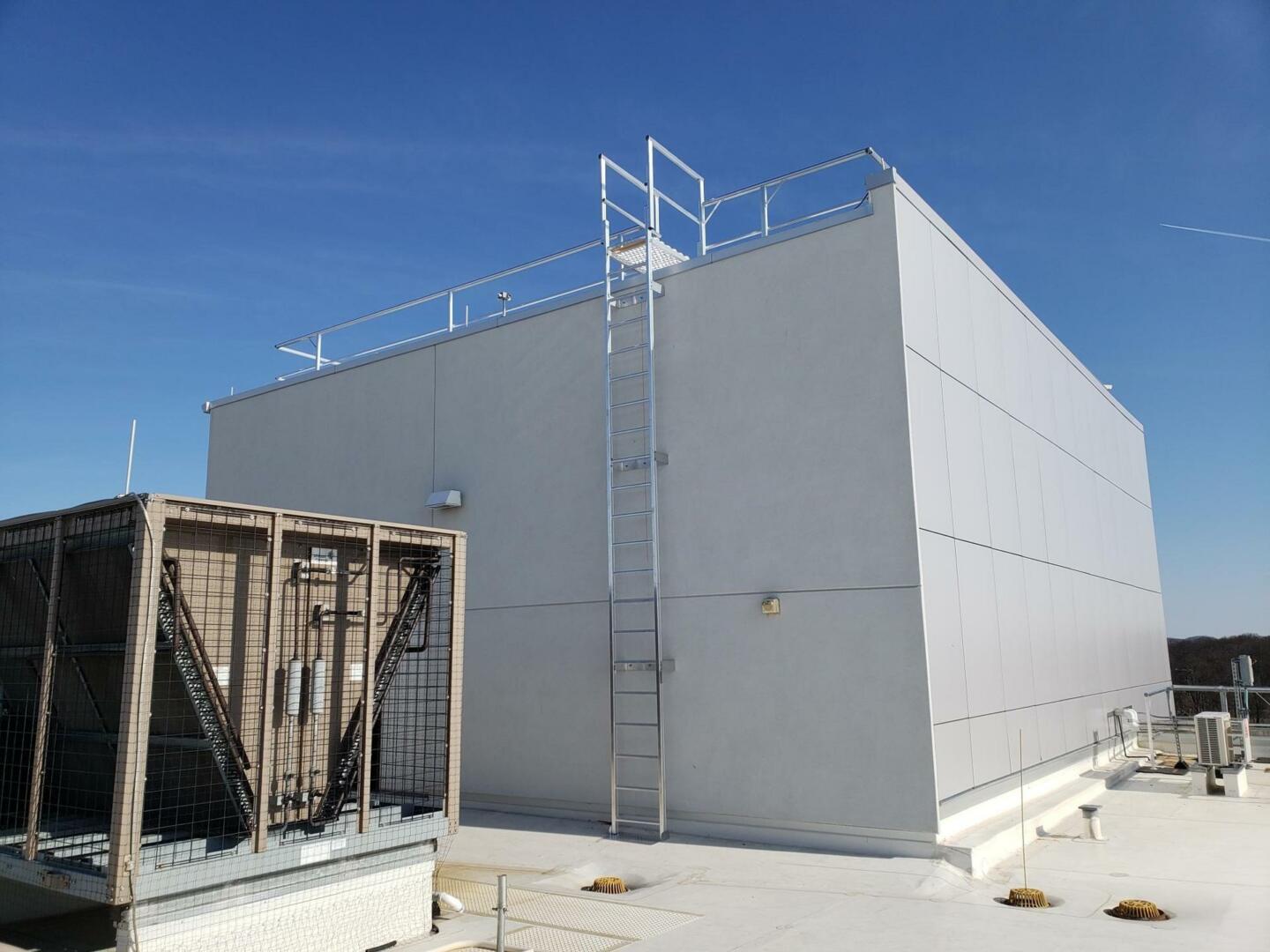
If your building has rooftop access ladders with safety cages, you may be wondering whether they’ll still meet OSHA requirements in the years ahead.
For decades, ladder cages were an accepted form of fall protection on fixed ladders. However, OSHA’s Walking-Working Surfaces standard (29 CFR 1910.28) changed the requirements for fixed ladders over 24 feet, prompting many facility owners to evaluate whether their existing ladders still comply.
The good news is that compliance doesn’t automatically mean replacing every caged ladder. In many cases, existing ladders can be retrofitted with a ladder safety system or personal fall arrest system, allowing you to improve worker safety while extending the life of your existing infrastructure.
In this article, we’ll explain what OSHA’s current requirements mean, which ladders may be affected, and how to determine the most practical path to compliance.
What Changed Under OSHA’s Fixed Ladder Rule?
Before determining whether your existing ladders need to be replaced or retrofitted, it’s important to understand OSHA’s current requirements.
One of the biggest sources of confusion is that OSHA’s Walking-Working Surfaces standard applies different requirements to existing fixed ladders and new installations.
Historically, fixed ladders exceeding 20 feet could use a cage, well, ladder safety system, or personal fall arrest system (PFAS) to satisfy OSHA requirements. As fall protection technology evolved, OSHA determined that ladder safety systems provide a higher level of protection than cages alone.
As a result, OSHA phased in new requirements. Fixed ladders over 24 feet installed after November 19, 2018, must be equipped with a ladder safety system or personal fall arrest system—cages alone are no longer compliant. Existing fixed ladders installed before that date remain grandfathered under the current standard and are scheduled to transition to a ladder safety system or PFAS by November 18, 2036.
The table below summarizes the current OSHA requirements.
Installation Date |
Current OSHA Requirement |
| Before Nov. 19, 2018 | Existing cages are grandfathered under the current rule. |
| After Nov. 19, 2018 | Fixed ladders over 24 feet must include a ladder safety system or PFAS. Cages alone are not compliant. |
| Current OSHA standard | Existing grandfathered ladders are scheduled to transition by Nov. 18, 2036 under the current OSHA standard. |
Do You Have to Remove Existing Ladder Cages?
One of the biggest misconceptions surrounding OSHA’s fixed ladder requirements is that every ladder cage must be removed.
Under the current OSHA standard, an existing cage or well may remain if it does not interfere with the operation of a compliant ladder safety system or personal fall arrest system. For many facilities, this means an existing ladder can be retrofitted instead of completely replaced.
The most appropriate solution depends on factors such as:
- Ladder condition
- Existing cage configuration
- Ladder height
- Available clearance
- Type of ladder safety system being installed
A professional assessment can determine the safest and most cost-effective approach.
For additional technical information, Kattsafe’s OSHA Caged Ladder Update Resource Center provides a helpful overview of ladder safety systems and retrofit considerations.
Which Ladders Are Affected?
Many commercial and industrial facilities have more fixed ladders than they realize. The current OSHA requirements generally apply to fixed ladders over 24 feet used to access elevated work areas.
Common examples include:
- Rooftop access ladders
- Mechanical equipment access
- Manufacturing facilities
- Industrial plants
- Water and wastewater treatment facilities
- Utility structures
- Tanks and silos
If your property has expanded over time, it’s possible different ladders were installed under different OSHA standards. Completing a ladder inventory today can help identify which access points should be evaluated.
Why Planning Ahead Makes Sense
Whether OSHA ultimately keeps or revises the current compliance timeline, planning ahead offers several advantages.
Rather than waiting until compliance becomes urgent, facility owners can:
- Spread ladder upgrades across multiple budget cycles
- Coordinate ladder upgrades with planned roof or capital projects
- Minimize disruption to daily operations
- Improve worker safety today
- Address potential compliance issues during routine maintenance
- Address aging access systems before they become larger issues
It’s also important to remember that certain repairs, modifications, or replacements may require an existing ladder to meet current OSHA requirements sooner than expected. Planning ahead allows these opportunities to be evaluated proactively instead of becoming unexpected project costs.
Retrofit Options for Existing Fixed Ladders
Every ladder is different, and the right solution depends on its design, condition, and intended use. Possible compliance solutions include:
Ladder Safety Systems
Permanent cable- or rail-based systems allow workers to remain continuously connected while climbing.
Ladder Replacement
If an existing ladder is structurally deficient or no longer suitable for retrofit, replacement may be the best long-term option.
An experienced fall protection specialist can evaluate your existing ladders and recommend the most practical path forward.
How to Prepare Your Facility
Whether your organization manages a single building or a large portfolio of properties, taking a proactive approach today can simplify future compliance efforts and support safer rooftop access.
We recommend:
- Inventory every fixed ladder on your property
- Identify ladders exceeding 24 feet
- Document installation dates when available
- Evaluate existing cages and ladder condition
- Schedule a professional compliance assessment
- Develop a phased retrofit plan that aligns with future maintenance budgets
Planning ahead allows facility owners to prioritize improvements, spread costs over time, and address safety concerns before they become larger projects.
Frequently Asked Questions
Do I have to remove my ladder cage?
Not necessarily. In many cases, existing cages may remain if they do not interfere with the operation of a compliant ladder safety system or personal fall arrest system. A professional evaluation can determine whether your existing ladder can be retrofitted.
What is a ladder safety system?
A ladder safety system is a permanent cable- or rail-based fall protection system that allows workers to remain continuously connected while climbing. These systems are designed to arrest a fall and have replaced cages as OSHA’s preferred method of fall protection for many fixed ladders.
Can I wait until 2036 to make upgrades?
While the current OSHA standard includes a 2036 transition date for certain existing ladders, waiting isn’t always the best strategy. Budget planning, scheduled facility improvements, and certain ladder modifications may make it more practical to upgrade sooner.
What if I modify or repair an existing ladder?
Certain repairs, alterations, or replacements may require the ladder to meet current OSHA requirements before any broader compliance deadline. If you’re already planning work on a fixed ladder, it’s a good opportunity to evaluate whether additional fall protection upgrades should be completed at the same time.
How do I know if my ladders are compliant?
The best place to start is with a comprehensive ladder assessment. A qualified fall protection specialist can inspect your ladders, identify applicable OSHA requirements, and recommend practical retrofit or replacement options based on your facility.
Plan Ahead with the Valcourt Group
Understanding OSHA’s fixed ladder requirements isn’t just about preparing for a future regulation—it’s about creating a safer workplace today. Whether you’re evaluating a single rooftop ladder or planning upgrades across an entire portfolio of facilities, a proactive assessment can help identify compliance needs, prioritize improvements, and develop a phased plan that aligns with your maintenance and capital budgets.
The Valcourt Group delivers turnkey Fall Protection Solutions that help commercial and industrial facility owners evaluate existing ladder systems, identify compliance requirements, and implement retrofit solutions designed to improve worker safety and support long-term regulatory compliance.
Ready to evaluate your fixed ladders and rooftop fall protection systems? Contact the Valcourt Group to schedule a fall protection assessment and discuss the right solution for your facility.